The Song of the Heart: Emma and the First Hymnbook
Every congregation that has ever sung its way through a hard Sunday is singing in Emma Smith's debt. In 1830 the Lord gave her a task of her own. The revelation that called her an elect lady also told her to "make a selection of sacred hymns, as it shall be given thee, which is pleasing unto me, to be had in my church." This page tells how a book of ninety hymn texts, the hymn collection dated 1835 and selected by Emma Smith, gave a young and scattered church a single voice.
A charge of her own
Doctrine and Covenants 25 promised Emma that "the song of the righteous is a prayer unto me," and that the Lord delights in "the song of the heart." The hymnbook was not a side task handed to her between other duties. It stood in the revelation beside comforting her husband and expounding the scriptures, one of the defining works of her life.
She began gathering early. Working with William W. Phelps, she selected hymns that were printed in Church newspapers in 1832, so Saints in different settlements could begin singing the same words. At a time when choosing hymns was work usually reserved for male clergy, a woman in her twenties decided what the Church would sing.
A book of words
The first Latter-day Saint hymnbook was prepared at Kirtland: A Collection of Sacred Hymns for the Church of the Latter Day Saints. The edition is dated 1835, and its title page names the hymns as selected by Emma Smith. The printing ran late, though. The Joseph Smith Papers, which publishes the book, notes that although it bears an 1835 date it was apparently not available until early 1836. It held ninety hymn texts and no musical notation at all, just words, gathered so that families and branches who had no songbook and perhaps no instrument could still carry the tunes they knew and learn new ones. The little book traveled where the Saints traveled, into homes and small meeting rooms, and it treated singing as something the whole church did together, not something performed for them.
Open that collection today and you will meet hymns the Church still sings. Her book carried "How Firm a Foundation," with its promise to the Saint who feels outnumbered by trouble: "Fear not, I am with thee; oh, be not dismayed." Generations who never learned Emma's name by heart have leaned on words she chose for them. That is a particular kind of leadership, quiet enough to be mistaken for background, and it is one of the most durable things she built.
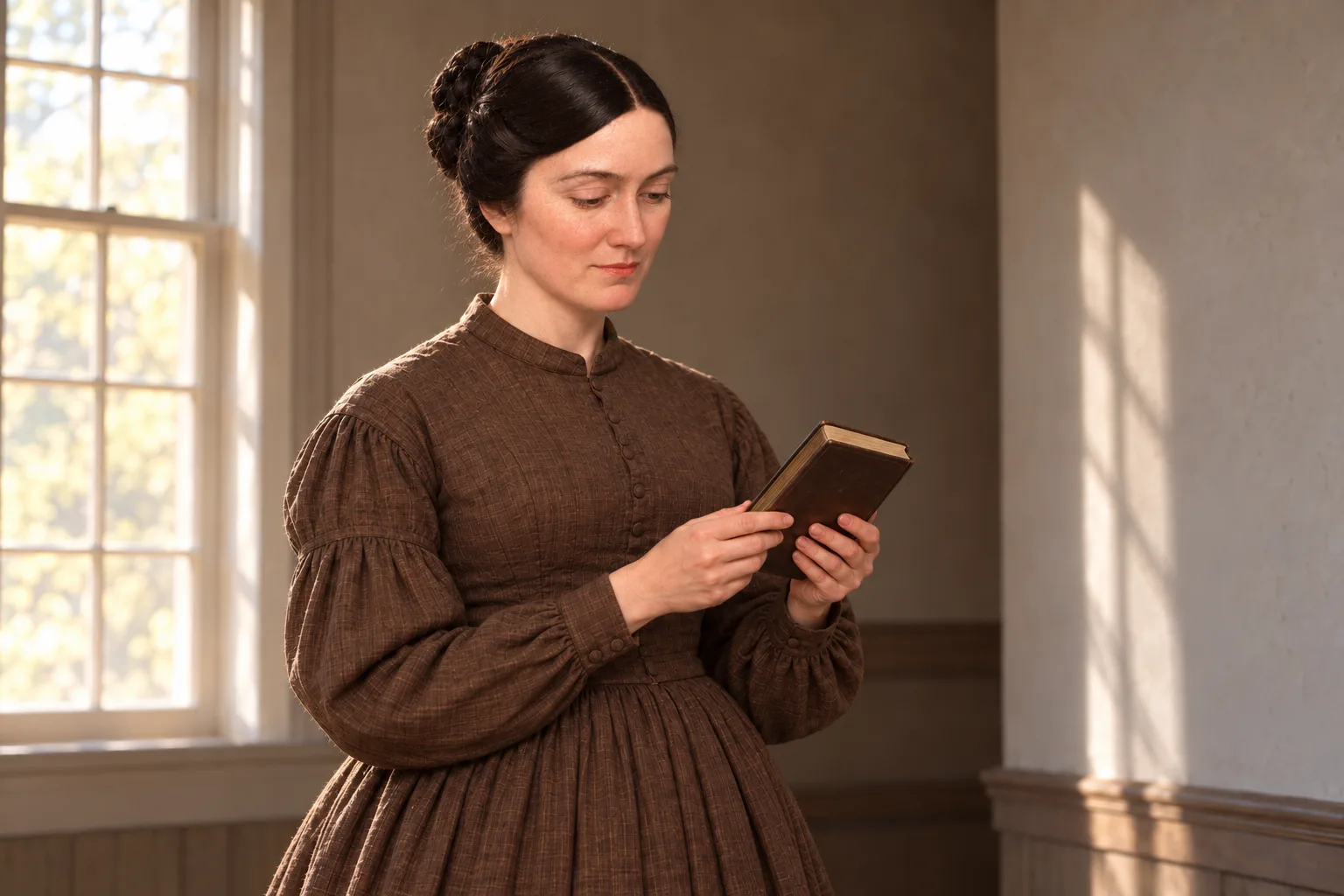
The finished hymnbook
The little book in her hands is the finished work: A Collection of Sacred Hymns, the selection of sacred hymns she was charged to make in Doctrine and Covenants 25. The edition is dated 1835, and the printed books reached the Saints early in 1836. What she holds here is the completed collection, ninety hymns she chose, small enough to carry into any home or meeting room where the Saints sang together.
Why her choices lasted
Emma selected for people who were suffering. The Saints of the 1830s were being gathered, scattered, and gathered again, and the hymns she favored speak of trust in God, the Savior's care, and courage to continue. Her collection taught doctrine the way Doctrine and Covenants 25 said it would: as prayer. A family that could not yet afford a hymnal of its own could still be taught, verse by verse, at the kitchen table.
Her own life kept testing the words. In the years after the book appeared she buried children, crossed a frozen river with four little ones, and organized relief for a city of refugees. Knowing her life, it is hard to read "the song of the heart" as only a fine phrase. It sounds like prayer that had to be carried, and was carried.
Pause and reflect
Which hymn has carried you through a hard season? What do you think the Lord meant by calling that song a prayer?
Emma chose words a whole people would pray in song. Let a hymn carry your prayer this week.
Emma's hymnbook gave scattered people the same words to sing. Whose voice could you join this week so they do not have to sing alone?
Sometimes company in the song is the comfort. Join a voice that has been singing alone.