The Winter Crossing: Emma Leads Her Children to Quincy
In the winter of 1838 and 1839, Emma Smith did the hardest traveling of her life with her husband in prison and her four children in her care. This is the story of how she crossed a frozen river on foot, carrying her baby and a priceless manuscript, and of the letter she wrote afterward that lets us hear her courage in her own words.
Explore this story
A family separated
The Saints had been driven from their homes in Missouri under threat of violence, and Joseph Smith and other Church leaders were held in Liberty Jail. Emma visited her husband there and carried letters between the prison and the scattered Saints. At home in Far West she had four children to feed and protect: Joseph III, who was six; Julia, seven; Frederick, two; and Alexander, a baby of eight months. The Saints were leaving Missouri for Illinois, and Emma had to get her family across the Mississippi River in the middle of winter.
The ice
In February 1839 Emma crossed the frozen Mississippi River on foot with her children, carrying eight-month-old Alexander. She also carried something entrusted to her care: the manuscript of Joseph's translation of the Bible, tucked beneath her skirt so it would cross safely with her. Think about what she chose to protect on that walk. Her children in her arms and against her skirt, and under her skirt, pages of scripture she believed the world would need. Faith, in Emma's life, was rarely an abstraction. It was weight she was willing to carry.
On the far shore lay Quincy, Illinois, where the residents opened their town to thousands of homeless Saints. Emma and the children were taken in, and the family found shelter and work while they waited for word about Joseph.
Her own words
From Quincy, on March 7, 1839, Emma wrote to Joseph in Liberty Jail. She told him about the children and about the kindness the family had received. She did not hide what the winter had cost her. She wrote of the suffering she had passed through since the militia came into Far West, and then she wrote the sentence her descendants have quoted ever since: "I still live and am yet willing to suffer more if it is the will of kind Heaven, that I should for your sake."
Read that sentence slowly. She does not claim the suffering was small. She does not promise she understands it. She says she is still here, and still willing. Emma's endurance was not a stiff upper lip. It was a decision, renewed in Quincy after she had left her home in Missouri, to keep loving and keep going for the people who depended on her.
Joseph escaped custody that spring and rejoined his family in Illinois, and the Saints began building again at the settlement that became Nauvoo. Emma's crossing was not the end of her hardships. But whenever the story of the Restoration tells of faith under pressure, her footprints are already on the ice.
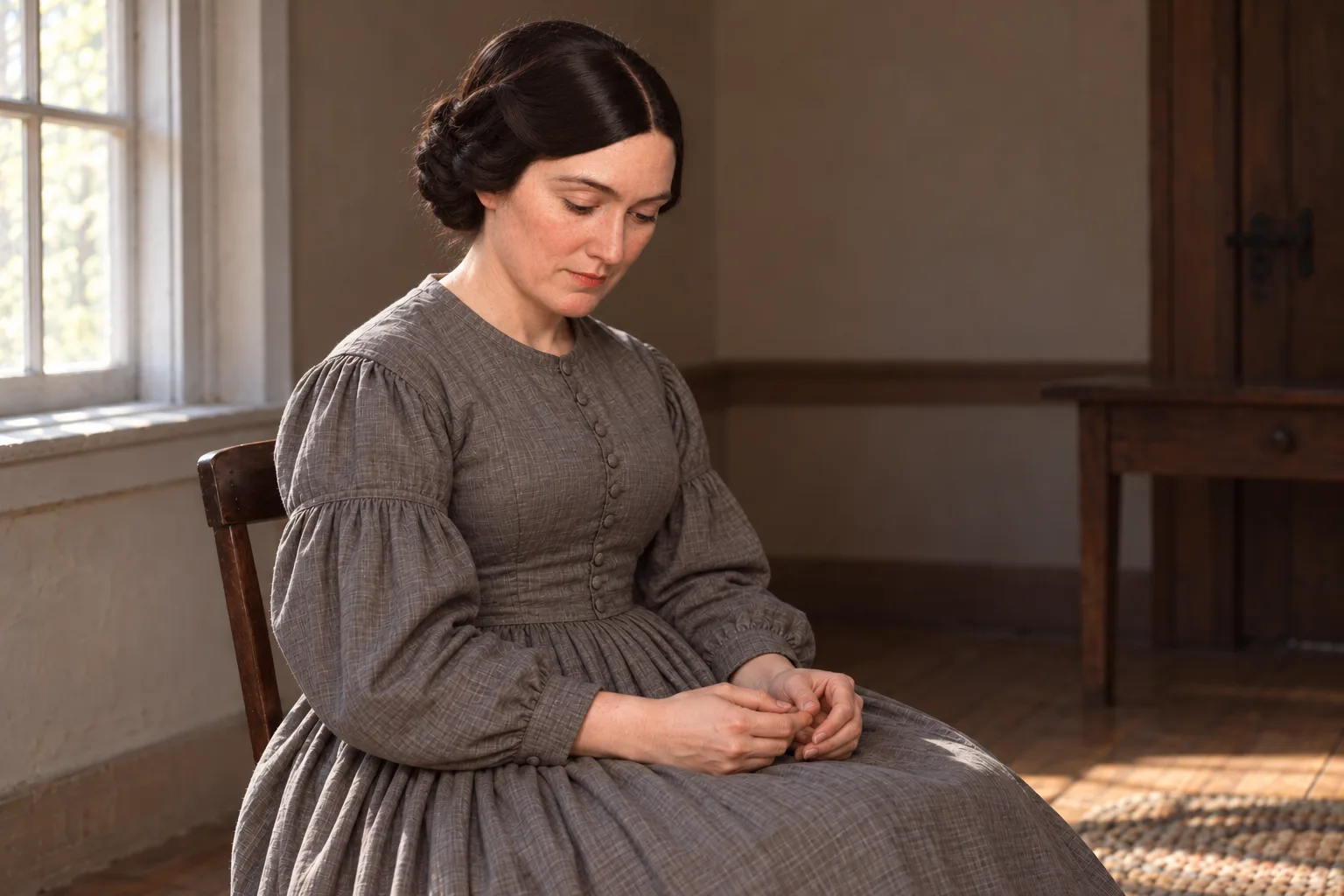
Emma in Quincy
This portrait belongs to Emma's Quincy season, the weeks after the crossing. It is not the crossing itself. It is the woman who wrote from Quincy on March 7, 1839, that she was still living and still willing. Her hands rest in her lap, work worn and uninjured: the hands that had carried her children over the ice and then picked up a pen.
Pause and reflect
Emma protected both her children and the scriptures on the same walk. What has God asked you to carry at the same time as your everyday responsibilities?
Emma carried her family and the record together. The Lord often trusts us with more than one precious thing at once.
Her letter names the suffering honestly and then chooses willingness. What would honest, willing words sound like in your own hardest season?
Emma did not pretend the suffering was small. Honesty first, then willingness, is a pattern worth borrowing.