Her Own Witness: Emma's Later Years in Nauvoo
When Joseph Smith was killed in June 1844, Emma was thirty-nine years old and expecting a child. Many accounts of the Restoration move west with the Saints and leave her standing in Nauvoo. Emma lived nearly thirty-five more years, and they were hers: years of providing for her children, making a home, choosing her own path, and stating, at the end of her life and in her own words, her testimony of the Book of Mormon. This page stays with her for those years.
A widow's work
David Hyrum Smith was born on November 17, 1844, in the November after his father's death. Emma now had children to support and hard questions to answer. Joseph had left no legal will, and disagreements grew between Emma and Brigham Young over property held in Joseph's name and the debts attached to it, questions that mattered to the Church and to a widow counting what she could keep for her children. She held on to the Mansion House and what she could claim for her family's support.
When most of the Saints left Nauvoo for the west in 1846, Emma stayed. During the violence of that year she took temporary refuge in Fulton, Illinois, and returned to Nauvoo a few months later, early in 1847. Illinois remained her home for the rest of her life. Staying was not the absence of a decision. It was her decision, made for her children and herself, and she lived with its costs and its dignities alike.
A second marriage and a full house
On December 23, 1847, Emma married Lewis C. Bidamon, a Nauvoo resident who was not a member of the Church. Their household in Nauvoo carried on through the following decades. In time Emma and Lewis moved into the completed portion of the Nauvoo House, which they ran as the Riverside Mansion boardinghouse, and welcoming boarders became part of her work in her last years.
Losses kept coming, as they had all her life. Her son Frederick died in 1862. Her youngest, David, suffered severe mental-health difficulties and was hospitalized in 1877, remaining in institutional care for the rest of his life. Of the children Emma bore and adopted, five reached adulthood. She knew their names and their struggles to the end.
A different path, told plainly
In 1860 Emma affiliated with the Reorganized Church of Jesus Christ of Latter Day Saints, today Community of Christ, in the same year her son Joseph III became that church's president. Her path after 1844 was not the path of the Saints who went west, and members of both churches have sometimes told her story as if it must belong to only one of them. The record supports something simpler and more human: a woman who remained in Nauvoo, raised her family in the community she chose, and kept her faith in the things she had witnessed, even as her church affiliation differed from the one her husband had founded and Brigham Young led west.
The testimony she kept
Near the end of her life, Emma sat for an interview with her son Joseph III and spoke about the Book of Mormon she had helped bring into the world as a young scribe at Harmony. This is what she said: "My belief is that the Book of Mormon is of divine authenticity—I have not the slightest doubt of it."
She had held the plates' box under her bed. She had written at the translation table. She had carried a later manuscript under her skirt across a frozen river. At seventy-four, when her son asked her about that book, she told him she had not the slightest doubt of it. Emma died in Nauvoo on April 30, 1879, and she is buried beside Joseph.
Lucy Mack Smith once said she had never seen a woman endure fatigue and hardship "with that unflinching courage, zeal, and patience, which she has always done." Emma's later years are where that sentence finishes. She was not only the woman who stood beside the Prophet at the beginning. She was a witness in her own right, and she remained one.
Her testimony
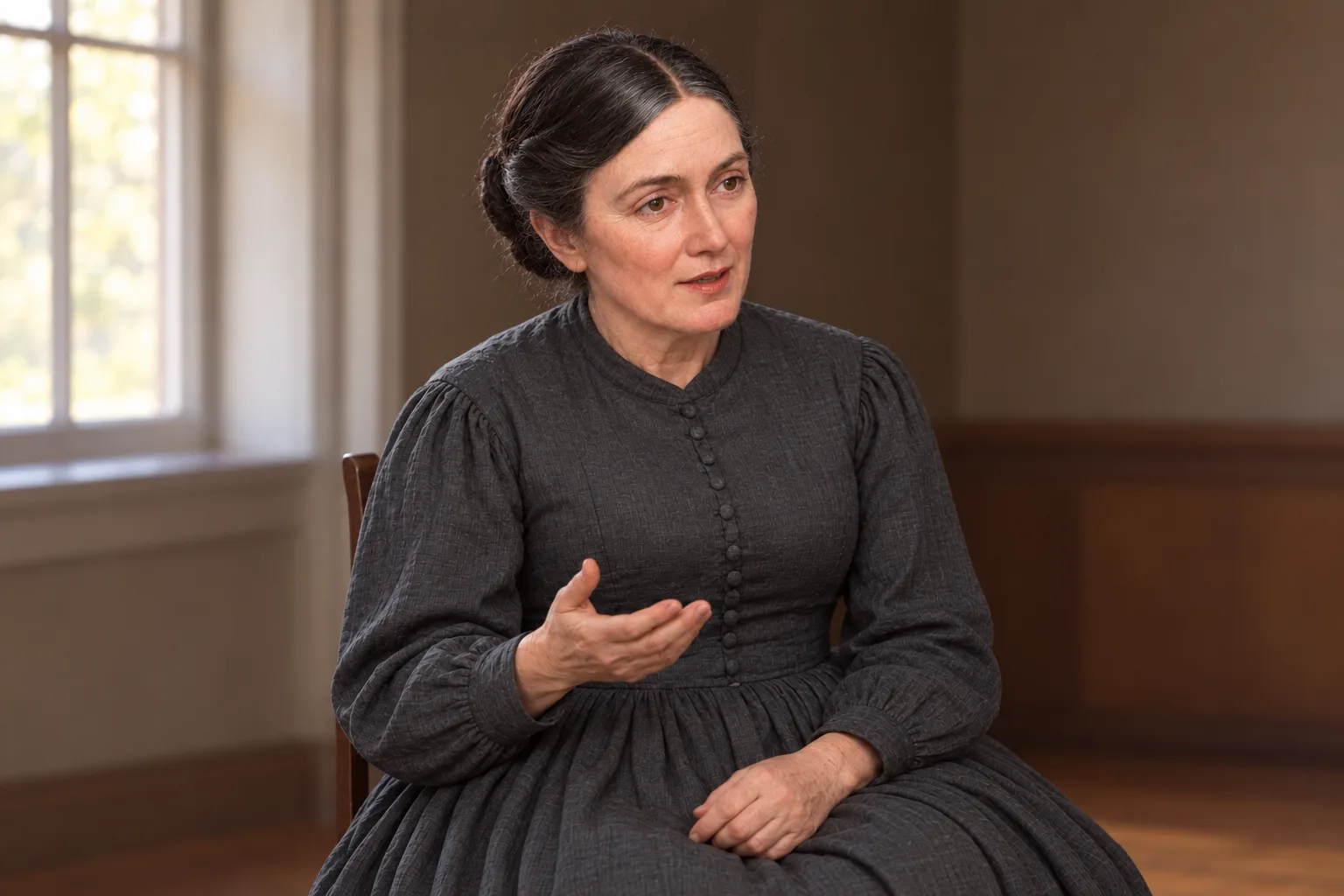
Near the end of her life, Emma spoke with her son Joseph III about the Book of Mormon, and after her death his account of their conversation was published. As her son Joseph III recorded it, her words were plain: 'My belief is that the Book of Mormon is of divine authenticity—I have not the slightest doubt of it.' That testimony was not new at seventy four. It was the same witness she had carried since Harmony, kept to the end of her life.
Pause and reflect
Emma's faithfulness did not require her life to look like anyone else's. How can you honor another person's honest path without needing it to match yours?
Emma's path after 1844 was her own, told plainly. There is room to honor honesty like that.
At the end of her life Emma testified of what she had known at the beginning. What do you know now that you want to still be saying, as steadily, many years from now?
She kept her witness to the end of her life. Consider which of yours you want to keep just as steadily.